4 Ways on How to Design a Perfect Mobile Marketing Strategy

Introduction

As an increasing number of consumers conduct product research and make purchases via their cellphones, no mobile marketing strategy is complete without mobile integration. Here is how you can get the most of your mobile marketing strategy by combining several types of mobile communication.

Mobile Websites

That’s a tough ask, indeed. Your company needs a mobile-friendly website if it wants to get noticed by people who only use their phones. A mobile-friendly site is different from a responsive site in important ways. Due to space limitations, the structure of a mobile website is different from that of a traditional desktop website. Faster loading times and better features for the end user are two signs that a mobile website is superior. If you presently have a responsive website, that’s excellent; if not, you should hire professional developers to construct one.

Mobile Apps

Mobile applications are another way to get your name out there and win over new customers. But you need to know everything there is to know about your target market before releasing one. Knowing your target demographic through and out is essential if you want to provide them with a useful and engaging mobile app. The choice between the program’s free and paid versions is also crucial. This occurs frequently in in-app model apps, which provide free basic functionality but require users to make in-app purchases to unlock more functionality.

Mobile Coupons

There are businesses that cater to customers that are interested in discounts and additional savings by offering coupons via mobile devices. Mobile vouchers that are dependent on the user’s current location are becoming increasingly common. Customers are able to save a considerable amount of money with each purchase thanks to these rebates.

Mobile Ads and Campaigns

To better engage with customers, businesses may now use mobile marketing to plan and carry out two-way interactions. This goal can be furthered with the help of mobile advertisements and campaigns, but it is no easy task to create and optimize a creative for a smaller screen. Ads on mobile devices, with their smaller screens, need to be clear and succinct to be read. The adverts should also feature a clear and simple call to action. Commercials are only effective if they appeal to the target audience and supply them with something they want or need.

Search Engine Optimization Strategies for Your Online Catalogue

Many consumers now prefer to shop online, therefore stores must ensure that their inventory is always accessible to customers. Customers searching for products similar to what you sell should see your product catalogue prominently displayed.

Improving your product catalog’s SEO will raise your rankings, raise awareness of your business, and increase site traffic. For businesses to successfully combat new competitors and increase sales, they must optimize their content for search engines.

  • Brand Names
  • Pictures of the Item for Sale
  • Costs of goods
  • Appropriate Keywords
  • General Description of the Goods

Brand Names

The name of the product is the most important aspect, therefore let’s start there. Customers can tell that this is the right product for them just by reading the titles. Customers will adopt your product more quickly if they understand what it is. A memorable brand name can help a product stand out in the marketplace.

A well-written title for a product increases its chances of being clicked on. Even if a consumer only wanted to go through a particular category using the site’s built-in navigation, this technique increases the likelihood that he will click and open the product in question.

Your product’s search engine rankings will increase if the title is compelling. When a product’s title is improved, it performs better in search results. Your title is read by search engine algorithms as they decide which products to show users. Having a title that is favourable to search engines is, therefore, a simple way to speed up the process of increasing your search ranks.

Pictures of the Item for Sale

Your product’s primary image conveys its essence and gives the buyer an immediate sense of its value. A high-quality photo of the actual thing is required to retain the product’s credibility. Post-click, a fuller 360-degree perspective of the products is showcased via thumbnails of the photographs from different angles. Customers appreciate having the option to view several pictures of pricey things before making a purchase.

Files saved as TIFF (.tif/.tiff), JPEG (.jpeg/.jpg), GIF (.gif), or PNG (.png) are strongly preferred. Consistency between the image’s background and the website’s design is also important.

Most websites would benefit from a white background, and Amazon specifically requires it. Add photographs or a video showing your product in action to help sell it.

Costs of goods

To a large extent, the number of people who click on your listing will depend on how much you’re charging for your product. In an online marketplace, you may face hundreds of other vendors selling the same product. Here’s where the cost differential becomes significant. Keeping product costs low or competitive can lead to more buyers discovering and purchasing your product.

Choose dynamic pricing to keep your offerings competitive, whether you’re selling on your own website or in a marketplace. When you set up a dynamic pricing arrangement with a vendor, they can change the price of your product at any time.

Appropriate Keywords

By using the appropriate keywords, a product might increase its search engine rankings. Try out a variety of keyword values on your products to see which ones result in the most clicks. It’s important to shop around because different markets have different character limits for keywords. This can be up to 50 characters long.

Amazon’s keyword field length is set by certain product categories. As a result, some groups can accommodate more keywords than others, while others may have to make concessions. To prevent under-utilization of this resource, make sure to verify the maximum allowed keyword counts for your individual product categories before you select the keywords.

General Description of the Goods

The most effective way to attract the attention of potential buyers and inform their purchasing decisions is through a detailed and accurate product description. Important features of the product should be highlighted in a bulleted list and placed either to the right or the bottom of the product image. Make it such that a buyer doesn’t have to dig too far to learn this information about your goods.

3 Ways to Promote Customer Retention

Free Crop unrecognizable woman carrying red shopping bags in studio Stock Photo

  • Be consistent if you want loyal customers
  • Frequently poll your customers with surveys
  • Get to know your customers on a personal level

Be consistent if you want loyal customers

If customers are consistently satisfied with their service, they are more likely to return to a business. Invest in training your frontline staff on how to consistently provide a memorable experience for customers.

The best way to improve how your business deals with customers is to hear suggestions from your own staff. Instead of giving your employees a specific script to follow in every interaction, provide them with a broad outline of the mindset you want them to adopt. Employees can refresh their knowledge and practice their skills in customer service by attending regularly scheduled training sessions where they can participate in role-playing exercises. Improved customer retention rates are directly proportional to the amount of training provided to staff.

Frequently poll your customers with surveys

Not all customers will express their satisfaction with a product. Customers who are dissatisfied may remain silent for a variety of reasons, including laziness, inability to switch vendors, or contractual obligations.

Don’t assume you understand your customers’ reactions to your offering; instead, poll them. Establish a routine of survey distribution using a channel most convenient for your clientele (email, phone, even in-person meetings). To learn how you’re doing and where you can make improvements, solicit this feedback.

Get to know your customers on a personal level

Personal connections between businesses and their customers are the foundation of lasting business partnerships. Of course it’s crucial to provide a high-quality item, but there are plenty of competitors who can do the same at the same or a lower price. To keep a customer for life, you need to develop personal relationships with them.

When a customer enters your shop the next time, put down what you’re doing and inquire as to how their day has been. Be quiet about your wares (unless they specifically ask, of course). Don’t talk about politics or religion; instead, ask about their kids, vacation, and favorite sports teams. If you make an honest effort, they will remember it and be more compelled to return at a later time.

Why You Should Care About Customer Online Reviews

Free Happy woman shopping online at home Stock Photo

Introduction

Here are four reasons why every local business owner should not only accept but actively seek out online reviews from their customers.

  • Consumers rely on a wide range of review platforms
  • Most people read reviews on the Internet
  • Consumers’ decision-making is influenced by reviews they read online
  • Most customers read reviews but few leave their own

Consumers rely on a wide range of review platforms

Amazon is one of the go-to destination for consumers seeking reviews online. You should be aware that product reviews can appear on Amazon even if you don’t sell on the site. Further, consumers may be researching your business via reviews they read on regional or industry-specific websites. In other words, it is beneficial for business if reviews are posted on as many sites as possible.

Most people read reviews on the Internet

Fifty percent of people surveyed by Ask Your Target Market said they “always” or “most of the time” read online reviews before making a purchase. Another 25% do so roughly 50% of the time. Only 16% of customers ever read reviews posted online, and 10% never do.

Consumers’ decision-making is influenced by reviews they read online

Three quarters of respondents place a high value on customer feedback posted online. Depending on your product or service, customers will either heavily or lightly rely on reviews. If you’re in the business of selling technology, for instance, you should know that seventy percent of consumers always or often read reviews before buying a new electronic device. Forty percent of consumers always or sometimes read reviews before making a purchase at a national chain store, while thirty-five percent always or sometimes read reviews before making a purchase at a local chain store, and twenty-three percent always or sometimes read reviews before making a purchase at a local chain store.

Most customers read reviews but few leave their own

You’re missing a golden opportunity to win over new customers and convince them to give your business a try if you don’t actively encourage your existing ones to share their positive experiences with others through online reviews. The small percentage of satisfied customers who take the time to write reviews has an outsized impact on how the rest of your potential customers perceive your company. The impact of a single negative review is magnified if reviewers are in short supply.

Essential Skills An Email Marketer Needs to Succeed

Free Silver Imac Near White Ceramic Kettle Stock Photo

  • Testing
  • Copywriting
  • Creativity
  • Focused on meeting deadlines

Testing

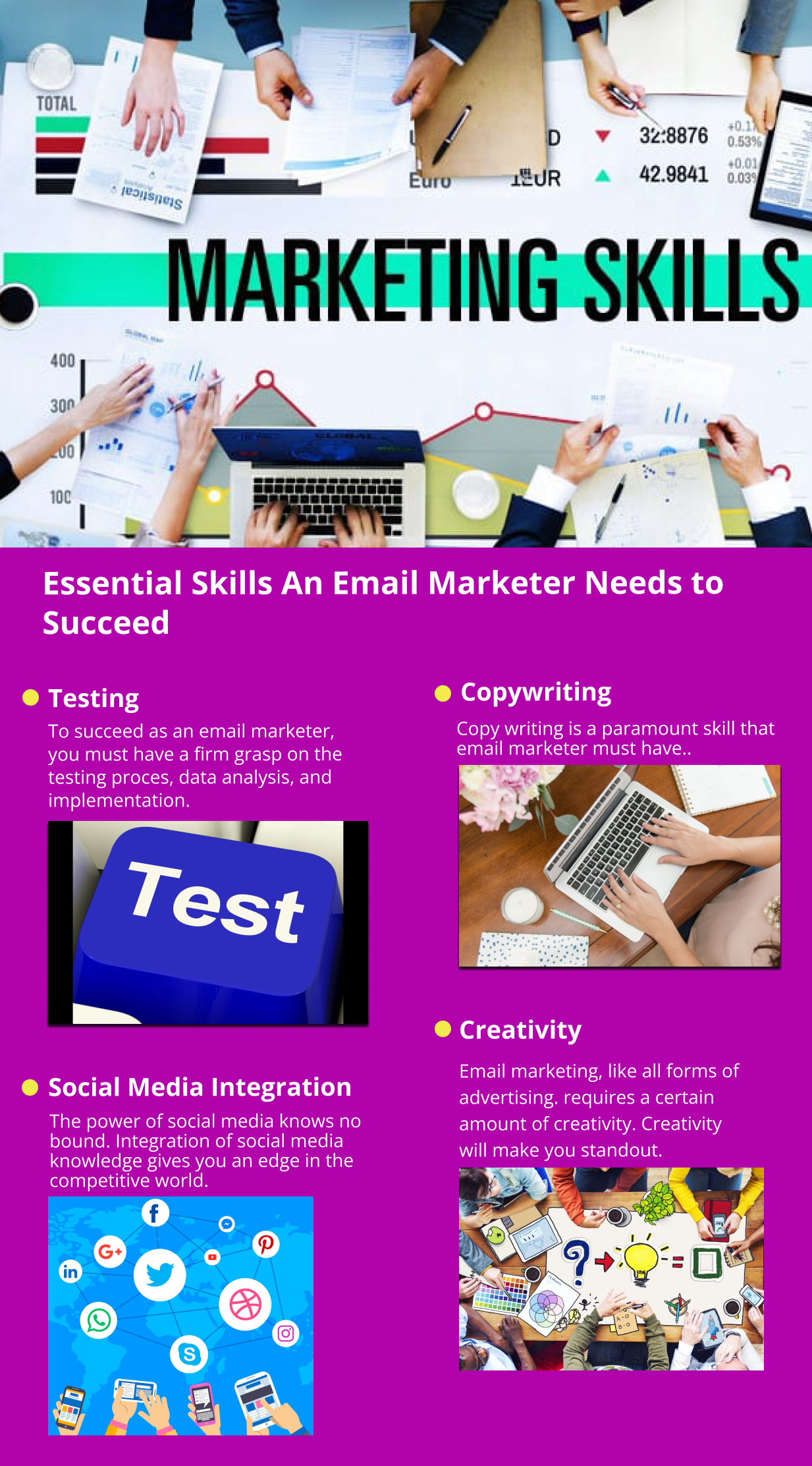
In order to succeed as an email marketer, you must have a firm grasp on the testing process, data analysis, and implementation.

Test-taking should be welcomed with nothing less than full enthusiasm. The creative aspects of marketing and copywriting need to be weighed against the practical considerations of running a business, and testing does just that. It’s also the best way to eliminate bias and make data-driven decisions about your email marketing strategy.

For the same email, ten different people will likely come up with ten different subject lines, each with their own justification for why they think it’s the best. You can learn which ones have the greatest effect on metrics like open rates, clickthroughs, and conversions by testing them.

Validation requires a body of knowledge and expertise that builds over time. More information about what works and how customers react will become available as your testing progresses.

Copywriting

Another marketing standard, this one has a version that is tailored specifically for email. Writing emails for marketing and sales purposes requires a unique combination of creativity on the front end and scientific rigor (in the form of data, testing, and other such activities) on the back end.

Email, in contrast to some other written forms, has no hard and fast rules. In general, its accepted wisdom that emails should be concise. We anticipate the need for a “subject line” and other standard features. Aside from that, there is no clear organizational structure.

Successful modern email copywriters know that “writing” often involves more than just words. It’s true that words matter; in the hands of a data-driven marketer, even a single word can make all the difference. However, in modern times, you may expand your vocabulary to include non-textual elements like emojis and memes.

Creativity

Email marketing, like all forms of advertising, requires a certain amount of creativity. As a matter of fact, it is crucial with email because customers get so many messages.

The most effective email marketers are always thinking of fresh ways to reach their audience and engage them in ways that will surprise and delight them. Ingenious sales pitches and innovative marketing strategies win over consumers. The status quo won’t cut it; you need to always be trying something new.

Creativity, likewise, can take many shapes. It’s not just a catchy ad slogan or witty turn of phrase. It is also how you utilize technology and data in inventive and novel ways.

Focused on meeting deadlines

Email marketing never ceases, particularly in an e-commerce or B2C context. It is difficult to keep track of all the important dates and corresponding deadlines on a calendar that is constantly updated.

Email marketing superstars rise to the challenge and disprove the stereotype of the disorganized creative professional.

Whether it’s a sale, Black Friday, or any other event-driven campaign, you must be able to hit your mark on the calendar because your emails must reach your customers’ inboxes on time to have any chance of having an impact.


5 Ways Responsive Design Improves Search Rankings:

Free Young lady typing on keyboard of laptop in living room Stock Photo

There are two main benefits to having a mobile-friendly website. One, to improve your site’s visibility in search engine results, and two, to provide the best possible user experience. Since Google favors mobile-friendly websites, you can’t afford to have a site that doesn’t adapt to different screen sizes and resolutions.

If you’re still confused as to how a responsive website could help your site’s search engine rankings, consider the following five potential benefits:

  • Reduce the time it takes for pages to load
  • Enhance the site’s usability
  • Lower the occurrence of “bounce rate”
  • Improve Reach therefore Social Sharing
  • Reduce the Problem of Duplicate Content

Reduce the time it takes for pages to load

It is now established that how quickly a page loads affects its search engine ranking.

As a marketing strategy, optimizing a website’s load time is essential. The faster a page loads, the happier its visitors will be. Google’s ranking preferences have always given priority to sites that load quickly.

Websites that are mobile-friendly and quick to load benefit both the user and the search engine in the long run.

Enhance the site’s usability

Users make snap decisions, so if you don’t provide a consistent and enjoyable experience across your entire site, they’ll probably never return. Google uses the amount of time a user spends on a page as a primary indicator of the page’s value for a given search term.

It is in this context that a mobile-friendly website proves useful. The reading and navigation experience on a responsive website is enhanced for the user. Increased time spent on the site and a better user experience are the end result.

Lower the occurrence of “bounce rate”

A site’s value can be measured in part by its bounce rate. How quickly do people leave your website is what this term refers to. Bounce rate is something Google takes note of.

According to Google, a high bounce rate means that visitors are leaving your site almost as quickly as they came. A big red flag that your material isn’t pertinent to the queries people have typed in.

Your site’s search engine rankings may suffer if you don’t monitor bounce rates.

Providing the best content possible for your readers is much easier when using a mobile-friendly, responsive website. Usually, you only show a small but crucial amount of information due to space and other constraints.

Fresh and pertinent information keeps readers interested and on your site for longer. A lower bounce rate means better search engine rankings for your website.

Improve Reach therefore Social Sharing

The mobile ecosystem is now crucial to the success of online businesses. This means there is a massive audience of mobile users eager to engage with your content.

Sharing on social media won’t improve your search engine rankings, but it will help you reach a much wider audience.

Having a larger fan base is a great way to boost website traffic, user participation, and brand awareness. The more people who visit your site, the more likes, shares, and recommendations it will receive. Sooner or later, Google will take notice of these signals and continue to favor your site.

Reduce the Problem of Duplicate Content

Having duplicate content issues is a nightmare if you decide to have a mobile site in addition to your main site. Even though the mobile and desktop versions of the site have different URLs, the content is identical in both versions.

This content duplication is detrimental to your search engine rankings. Since mobile versions of websites often get canonicalized to their desktop counterparts, they often struggle to rank well in search engines.

Responsive websites are more adept at handling duplicate content because the URLs and page content are consistent across all devices. You can access the same content from the same URL on any mobile device, including smartphones and tablets.

6 Reasons Your Organic Traffic is Declining

Free Black Samsung Tablet Computer Stock Photo

Table of Contents

  • Website Recently Changed
  • Google’s Most Recent Changes
  • Ranking Pages Dropped Off Index
  • Recent Changes in Google SERP
  • The number of backlinks and referring domains drops
  • You have un-optimized alt tags for your images on your website

Website Recently Changed

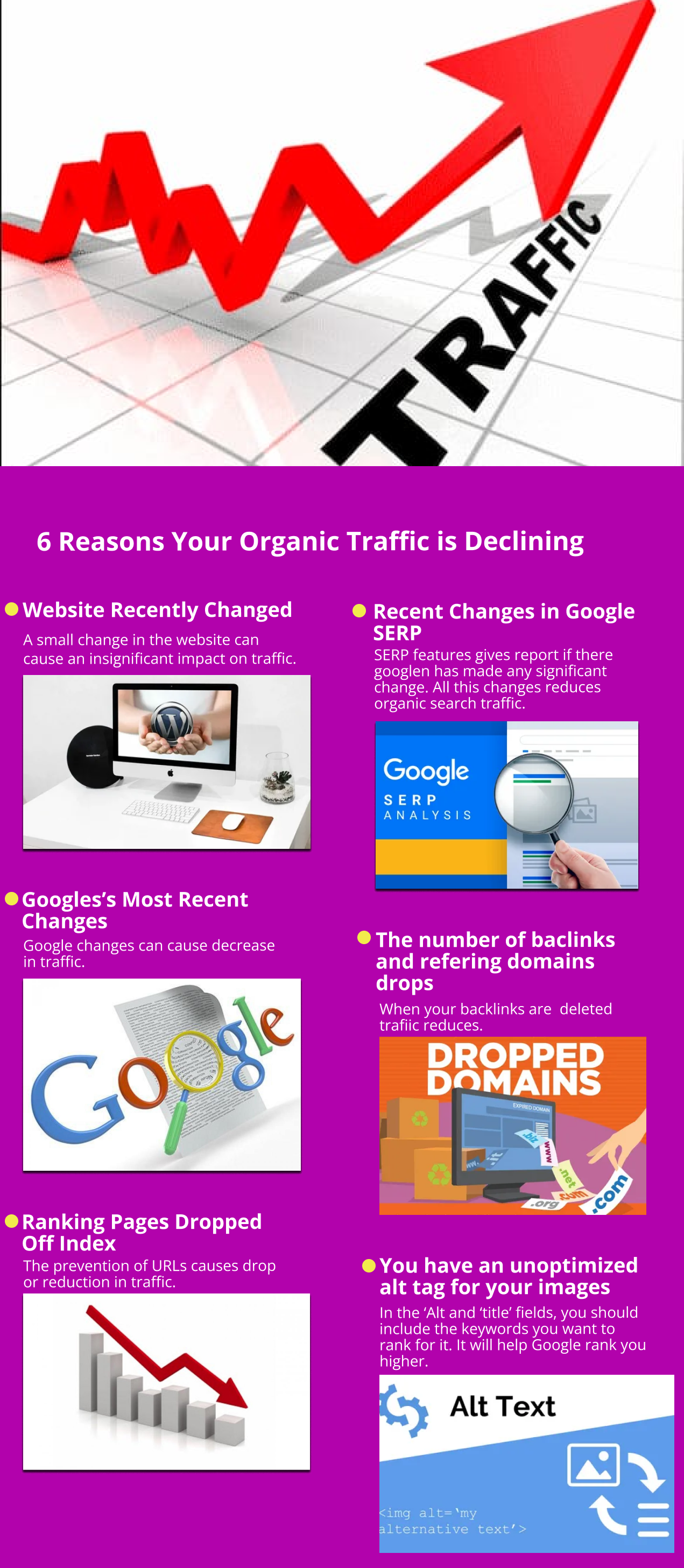
It’s possible that’s what’s going to happen. Sometimes even a small change to a website can have a significant impact on traffic. It’s possible that your SEO traffic has fluctuated if you’ve recently changed your website’s URLs (or moved them to another location), switched to a different JavaScript framework, or updated all of your title tags. You may have noticed a large fluctuation in your readings because of one or more of these factors.

Google’s Most Recent Changes

When it comes to SEO traffic, a recent Google algorithm update may be to blame for the decrease. Google is well-known for regularly releasing updates to its ranking algorithm in order to better serve searchers and eliminate spam. However, it’s hard to tell what kind of Google update just occurred. Penguin and Panda are two of the most common penalties imposed by Google on websites. Penguin is designed to target link farms, while Panda aims to combat content spam.

Ranking Pages Dropped Off Index

It’s possible that some of your high-ranking pages were accidentally dropped from Google’s index. Check the Index Status Report in your search console account to see if any of your website URLs have suddenly stopped being indexed. The URLs may have been disallowed or not indexed through robots.txt, Meta tags on the page, or HTTP headers if this is found to be the case. If this is the case, you need to get on top of these issues right away.

Recent Changes in Google SERP

The SERP features report from Moz can help you find out whether or not Google has made any significant changes to its SERP. Google has a reputation for quickly changing the way its search results are displayed. A local pack can be added to the search results, or relevant queries can be shown directly in the results. You should be aware that any or all of these changes will reduce your organic search traffic.

The number of backlinks and referring domains drops

The backlinks to your website may have been deleted for a variety of reasons. In turn, the decrease in website traffic followed. Additionally, some of the backlinks may no longer be accessible. Choose Ahrefs for a bird’s eye view of your backlinks’ problems. A great way to see if you’ve lost any backlinks or referring domains is by using this tool.

You have un-optimized alt tags for your images on your website

Your SEO efforts will benefit greatly from the use of images. Marketers, on the other hand, frequently fail to take this into account. Users can find your images in the images tab if they are SEO-optimized.

The process of optimizing images is straightforward. There are only two things left to do for each image on your website: alt text and a file title. In the ‘Alt’ and ‘title’ fields, you should include the keywords you want to rank for. It will help Google rank you higher for the searches your target audience conducts in your area.


Customer Acquisition Strategies You Can Try Out

Free Focused elegant senior man and adult woman in smart casual outfit working on project with laptop and notes together in modern workspace Stock Photo

The cost of customer acquisition is an important factor in determining the value of a customer to a company or organization. Acquisition management refers to a set of methods and systems for handling customer inquiries generated by various marketing methods.

  • Influencer Sponsorships
  • Paid Advertising
  • Email
  • Traditional Advertising
  • Referral Programs
  • Search Engine Optimization
  • Content Marketing
  • Audience Building

Influencer Sponsorships

Today’s influencers are easily accessible, and as a result, their views are weighty. In response, an increasing number of businesses are utilizing influencer marketing strategies. When a business decides to work with an influencer, it typically provides the influencer with some sort of freebie. There are a number of ways that a product or service can be rated by an influencer.

Paid Advertising

You can reach new customers much more quickly with paid advertising than any other method. In contrast to organic marketing, paid advertising buys ads that you can target to a specific audience.

Email

Email marketing is a low-cost, quick, and flexible way to attract new customers and keep existing ones coming back to your website. With email marketing, you can target and personalize your messages to specific audiences.

Traditional Advertising

Offline channels are used in traditional marketing to promote goods, services, and companies and attract their target audiences. The growth and development of your business necessitates the use of traditional marketing, including online marketing channels.

Referral Programs

Customers will help your business grow through referrals if you run a successful business. However, it is likely to draw in more customers. A skilled salesperson and a lot of time and effort are required to move from a smaller, less profitable account to a more extensive, more profitable one.

Search Engine Optimization

Search engine optimization (SEO) is the practice of gaining traffic from search engine results that are free, organic, editorial, or natural. The goal is to raise the website’s search engine ranking.

Content Marketing

Content marketing aids in attracting viewers, fostering relationships, and ultimately boosting sales.

Audience Building

Developing your audience is critical for any business, and you may be doing it already without even realizing.

How to Improve the SEO of an Ecommerce Website

Failure to optimize your e-commerce website will result in lost revenue. Profit forecasts may suffer as a result. This is where Ecommerce SEO comes in handy for brands. It’s a legal way to boost your ranks, visibility, and website traffic. However, things are not as simple as they look. To get the momentum you need, you must use a failsafe and potent SEO strategy. Consider a number of essential SEO variables when working on your e-commerce website.

  1. Keyword Research

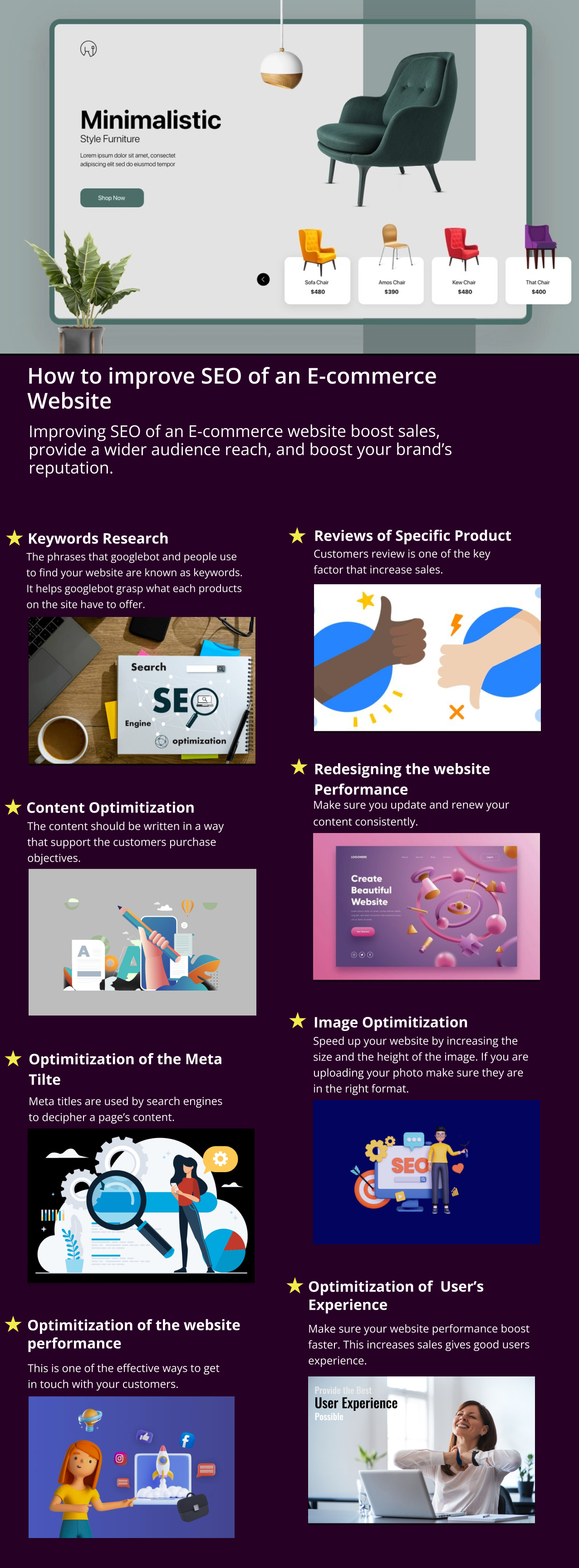
The phrases that Googlebot and people use to find your website are known as keywords. When it comes to e-commerce sites, it helps Googlebot grasp what each page or product on the site has to offer to increase your product’s search engine visibility, ensure that it is properly optimized using the right set of keywords. Search engines and customers alike benefit from keywords that are thoroughly researched and relevant.

A wide variety of free and paid keyword research tools are available to help you find relevant keywords for your business or items. Moz, Ubersuggest, AHREF, and Google Trends are all good resources for keyword research. The tools can provide you a lot of information about how well your keywords match up with what people are looking for.

  1. Content Optimization

Consumers are the focus of e-commerce. As a result, the information needs to be tailored to the audience in mind. Ideally, it should be written in a way that supports the customer’s purchase objectives. An ecommerce website has a number of content-required sections. Categories and blogs can be found on these pages.

Look at the websites of your competitors while you’re composing the product page. It will shed light on how their product pages are organized. Keep an eye out for out-of-stock and obsolete products on the product page. Remove them if there are only a few. The ranking may be harmed if certain products remain in the index for an extended period of time.

Your e-commerce site needs a blog to function properly. Sharing product information and other helpful resources with your consumers is made easier with this tool. You may increase traffic to your e-commerce site by optimizing your blog posts.

Make sure your blog article contains keywords that will help your page rise in the search engine ranks. Some of the most often asked issues, such as how to utilize the product, the benefits and drawbacks, and how to handle the money, would be great for the blog to address. In addition to engaging text, employ stunning and instructive images to boost user engagement. In addition, the blogs should serve as a conduit to the most important sections and elements of the website.

  1. Optimization of the Meta Title

Meta titles are used by search engines to decipher a page’s content. Well-optimized meta titles and descriptions.

Provide a brief explanation of the page’s topic in the Meta title and description for your product pages. It’ll make it easier for customers to find and understand your page.

It’s getting harder and harder to keep up with the competition. In order to exceed your competition, you need to be unique and stand out. Products that are almost identical can be difficult to describe in product descriptions because of this. Duplicating product descriptions may harm SEO and the user experience on a website with tens of thousands of product pages.

For tens of thousands of product pages in an online store, it is practically impossible to write completely unique descriptions. In order to get out of this situation, though, you must be unique. Duplicate descriptions annoy Google, so avoid them at all costs. If you don’t have separate descriptions, you won’t be able to benefit from SEO.

If you want your products to appear high in Google’s search results, be sure to include a detailed description of each one. Make certain that the descriptions you write are unique and fresh. As a result, you should write a separate and easy-to-read description for each product you offer.” Not a single copy.

  1. Reviews of Specific Products

Customer deterrence is unlikely if you make exaggerated claims. Consumer reviews are often a deciding factor when it comes to major purchases. In order to find out more information about a product, consumers turn to third-party review sites that provide third-party, unbiased feedback. Pre-purchase research is heavily influenced by customer reviews found online and word-of-mouth referrals.

Increased authority and trust in a brand comes from more positive evaluations on its page. There won’t be any repercussions as long as there aren’t many nasty comments. Search engine optimization (SEO) relies heavily on user reviews. You should allow customers to rate and review products on your e-commerce site. If a website’s owners aren’t paying attention to user comments, the site’s SEO could suffer. In a single month, an e-commerce site’s traffic can climb by roughly 30 percent, according to research.

Regardless of whether the reviews are positive or negative, they should be allowed. Permitting user evaluations on your website is usually a smart idea from an SEO perspective. As an added precaution, establish a streamlined system for identifying and removing fake reviews from the website.

It may appear suspicious and spammy if all of a product’s reviews are positive. It implies a lack of originality when it comes to publishing reviews online. By encouraging visitors to post reviews, you will be able to supply search engines and potential clients with a steady supply of new content.

  1. Optimization of the website’s performance

The new Google method places a premium on how quickly a page loads for the user. A website loading time is not something Google wants its users to endure. One of the many reasons customers leave your website or shopping cart without making a purchase is a slow website loading time. Keep an eye on your website’s loading time if you run an e-commerce business. It might be really expensive. Obviously, the longer your website takes to load, the more likely it is that visitors will abandon your site, or that they will have a low conversion rate or high bounce rate.

Page loading times of 2-3 seconds are considered ideal by experts. Traffic and revenue could be lost if the wait time exceeds three seconds. So, how can you make your website load faster? Before choosing on a web host, ask around for recommendations. Add a caching plugin to your site to further improve it.

Web servers are put under a lot of strain by e-commerce websites, which feature a large number of connected products. As time goes on, this slows down the webpage. Reduce the size of image files and speed up website load times by using an image optimization plugin.

  1. Redesigning the website

Your website’s design also needs to be taken into consideration. Many websites focus solely on building an online store and inventing ways to generate revenue. However, building and redesigning a website correctly is the harder challenge. It is imperative that the website be responsive and optimized for different screen sizes. Both search engine optimization and the user experience of an ecommerce website should be prioritized. If a website’s design and/or makeover are done correctly, a 75% increase in organic traffic is conceivable.

  1. Image Optimization

The visual of the product is the next thing we’ll look at. You may speed up your website by reducing the size and weight of your images. There are several things to consider when it comes to photographing. If you’re uploading photos, make sure they’re in the correct format (JPG, PNG, etc.). Images should be compressed using several fermium image compression tools before uploading. Last but not least, for images containing keywords, create alternative text and an image description.

  1. Optimization of the user’s experience

Your e-commerce site’s user experience is of the utmost importance. Performing regular usability evaluations on your website is critical for your SEO. As part of the audit, you’ll learn things like how long a user spends on a page, how many visitors leave, and the most popular pages. Customers should be able to easily find your goods on your website’s navigation. Your website’s navigation menu should be easy to understand so that visitors can quickly get to the most important parts of your site.

Both technical and non-technical elements can have an impact on usability. As soon as you notice any errors, go out and fix them. Don’t let anything harm the user experience, which is now an important ranking signal. There are a number of issues that can negatively effect a website’s user experience (UX), including a product page with frequent ad pops, bad content copy, fonts that are too large or small, or a color scheme that strains the eyes.


Reasons why Email Marketing is Still Essential

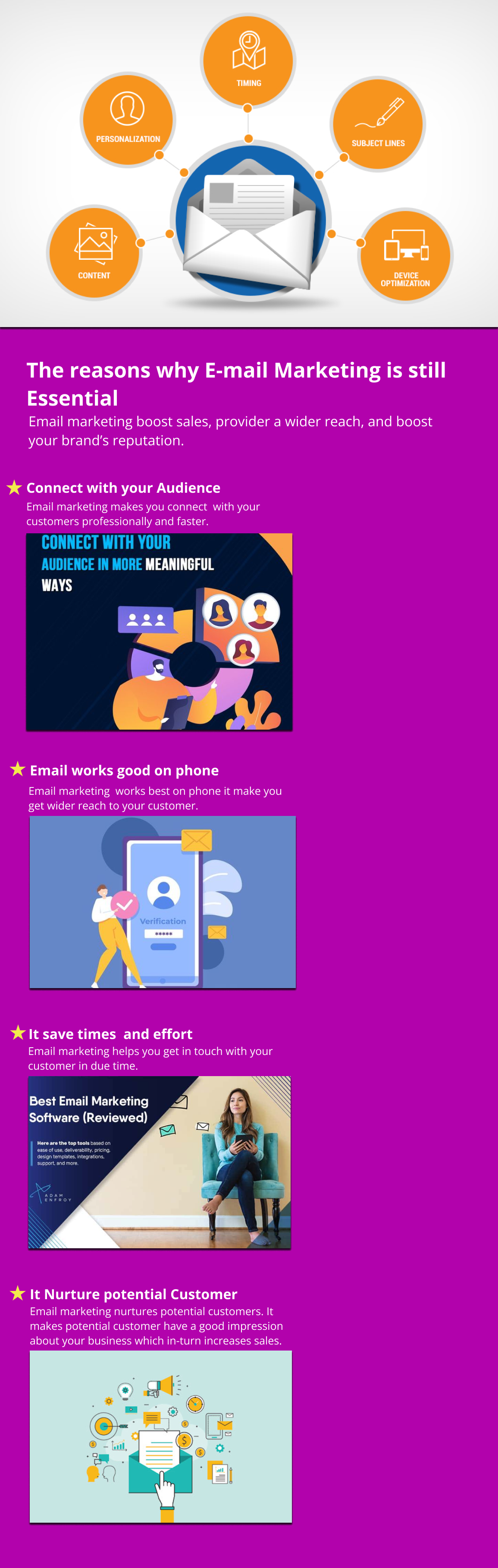
Marketers were found to be more inclined to work on mobile devices and to prefer small screens than huge desktop configurations. With email marketing’s dwindling popularity, it’s become common knowledge that it’s either dead or has been reduced to a tool for generating cold leads.

  1. Many people prefer e-mails over text messages

In order to keep you up to date on the future digital marketing seminar in your city, please include any other methods of communication, such as email or social media. It’s pointless to send a text message in this situation. Email campaigns are necessary to inform and engage customers about these new features. Marketers and customers alike may benefit much from the information contained in email sequences.

  1. Emails allow for more precision in the transmission of information

As a digital marketing strategy, email marketing serves as a useful supplement to all other channels. Emailing your consumers is a must if you plan to use social media to promote your business. As soon as your PPC strategy changes, you’ll need to notify your customers via email. This list includes webinars, branding, promotions, and more. In order to effectively communicate with customers, email marketing is the only realistic option.

  1. More Affordable Than Other Media

Email marketing is unbeatable in terms of ROI if that is all that matters. In terms of expense, it is one of the most cost-effective marketing tactics. Your campaign’s failure isn’t fatal compared to other high-cost marketing tactics like pay-per-click advertising or television advertisements. Many thanks for the low cost.

  1. Emails Have a Higher Chance of Conversion

According to the data, I’m on the right track. Supposedly, email marketing has a 40-fold higher conversion rate than social media platforms like Facebook and Twitter. Having a well-crafted email campaign with compelling copy, eye-catching images, and strategically positioned call-to-action buttons will draw a large number of recipients. The campaign’s open and click-through rates will rise as a result.

  1. Email marketing is growing exponentially

Email open rates have skyrocketed since people started opening them on their mobile devices, and now marketers have more alternatives than ever before.

  1. Emails still Build Relationships

Emails can now be used for more than just sending a message to the recipient’s inbox. Marketers are now archiving and combining all of their campaigns using this method. Begin circulating excerpts to your readers to let them know that your new blog is available. Promote your new social media or other campaign by sending out an email to those who haven’t already signed up.

  1. Affordability of email marketing

Email marketing is less expensive and more effective than other digital marketing methods. If you already have a verified email list of subscribers, you may use an email marketing solution from a reliable company like to reach your potential customers. The acquisition of hundreds of new clients can be achieved by spending a few hundred dollars on email lists. In order to promote your brand, increase the amount of money you spend on email marketing and invest in eye-catching email designs. This is a brand-new approach to fostering customer loyalty and involvement with a product or service.